An open source, unified model and set of language-specific SDKs for defining and executing data processing workflows
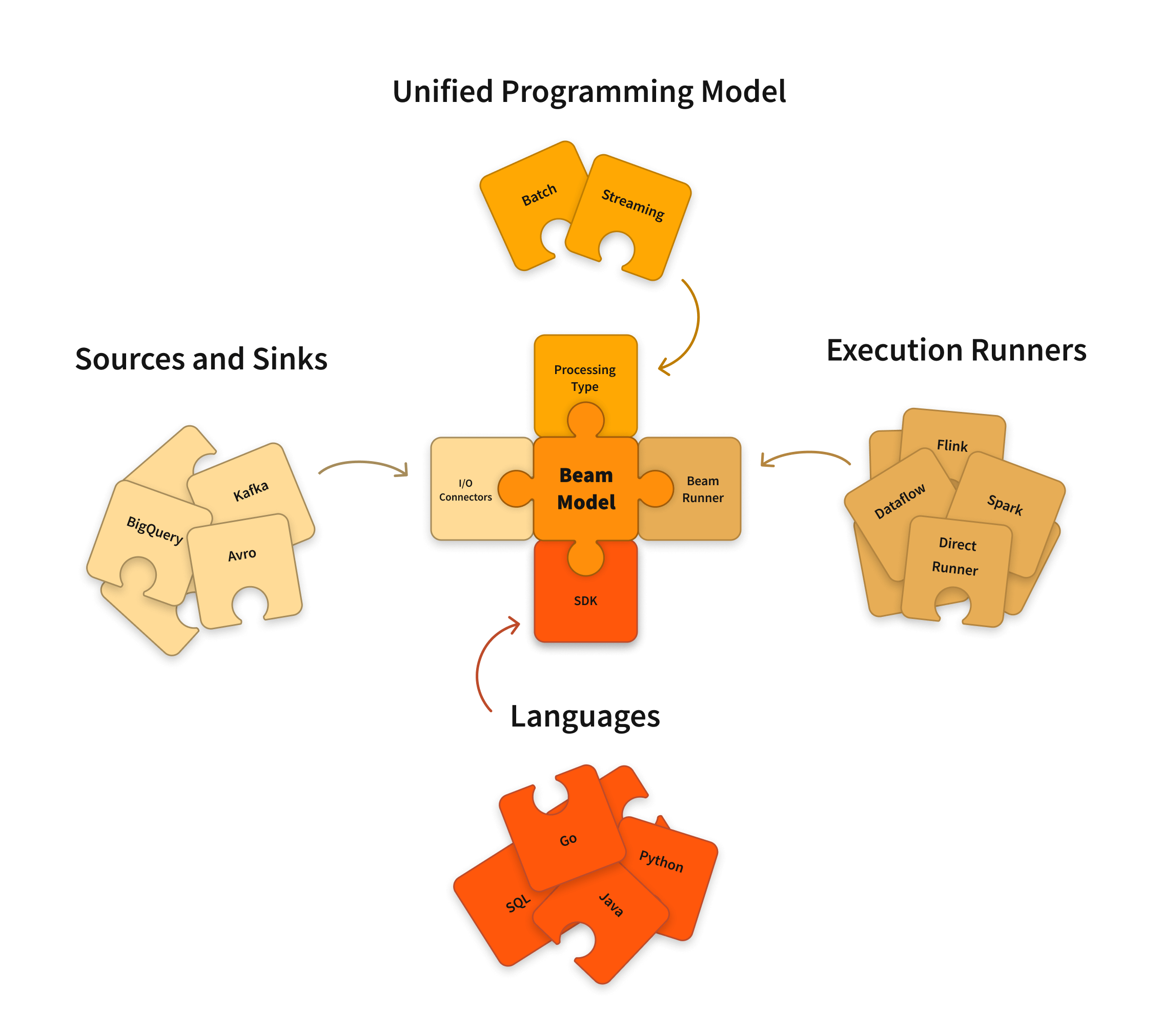
Apache Beam is an open source, unified model and set of language-specific SDKs for defining and executing data processing workflows, and also data ingestion and integration flows, supporting Enterprise Integration Patterns (EIPs) and Domain Specific Languages (DSLs). Dataflow pipelines simplify the mechanics of large-scale batch and streaming data processing and can run on a number of runtimes like Apache Flink, Apache Spark, and Google Cloud Dataflow (a cloud service). Beam also brings DSL in different languages, allowing users to easily implement their data integration processes.

Unstructured Data
[!info] Perplexity Query (2025-10-21T18:29:08.666Z) Question: Write a comprehensive one-page article about "Apache Beam". Model: sonar-pro
Apache Beam is an open-source, unified programming model designed for defining and executing data processing pipelines for both batch and streaming workloads managed by The Apache Software Foundation. Its significance lies in enabling organizations to process massive volumes of data flexibly, efficiently, and with minimal complexity—catering to the increasing demands of real-time analytics, machine learning, and data-driven decision-making. [^e0xmbw] [^ez6ljz] [^9r3h9m]
!Apache Beam concept diagram or illustration
Main Content
At its core, Apache Beam abstracts data processing workflows into three key components: Pipeline, PCollection, and PTransform. A pipeline is the blueprint of the end-to-end data processing job, from data ingestion and transformation to its ultimate sink. The PCollection serves as the data container, accommodating both bounded (finite) and unbounded (infinite/streaming) data. PTransform defines the computation or transformation steps applied to the collections—such as filtering, aggregating, or mapping data. [^e0xmbw] [^ez6ljz] [^9r3h9m]
For example, a retail company could employ Beam to construct a pipeline that reads customer purchase logs, applies real-time fraud detection (streaming), and generates daily sales reports (batch). Pipelines are written using Beam’s SDKs—currently available in Java, Python, and Go—and run on various backends called runners, including Apache Spark, Apache Flink, Google Cloud Dataflow, Samza, and Hazelcast Jet. [^e0xmbw] [^b9odou] [^ztsqx3] This portability means that once a pipeline is defined, it can be executed on multiple platforms without changing the core logic.
- Unified model: Use one API for both batch and stream processing.
- Portability: Write once, run anywhere via runners.
- Extensibility: Build custom SDKs, connectors, and transforms.
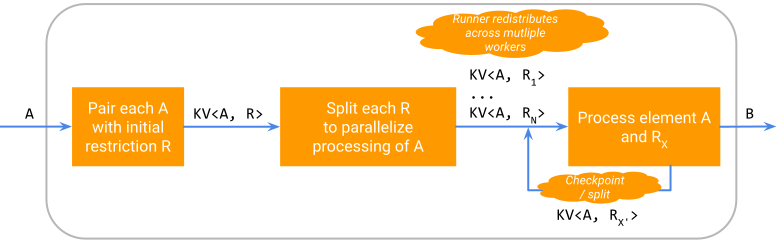
- Advanced features: Windowing, triggers, watermarks, and state management enable precise control over streaming data, such as grouping events into 1-minute windows or handling late-arriving data. [^ez6ljz] [^jqeb36]
However, challenges exist, primarily around mastering its abstractions—especially for teams new to data engineering. Integration across legacy systems, complex pipeline debugging, and variable runner implementations can also pose hurdles. [^e0xmbw] [^jqeb36]
!Apache Beam practical example or use case
Current State and Trends
Recent developments include enhanced support for Python and Go SDKs, expanded runner compatibility, improved monitoring tools, and tighter integration with cloud-native storage and messaging services. The community continues to invest in usability, performance optimizations, and expanding its library of connectors for diverse data sources. [^ztsqx3]
!Apache Beam future trends or technology visualization

Future Outlook
Looking forward, Apache Beam is poised to play a central role in the convergence of batch and streaming paradigms. Anticipated innovations include deeper integration with machine learning toolkits, lower-latency execution engines, better support for data governance, and more seamless cloud-native deployments. As real-time data analytics become ubiquitous, Beam’s unified architecture is likely to drive further efficiency and flexibility in enterprise data processing.
In summary, Apache Beam provides a powerful framework for modern data processing needs, unifying the worlds of batch and streaming under a single, extensible model. Its ongoing development and broad adoption signal a future of increasingly intelligent, real-time, and scalable data-driven applications.
Citations
[^e0xmbw]: 2025, Oct 20. Apache Beam: A Basic Guide - LoginRadius. Published: 2020-10-16 | Updated: 2025-10-20
[^ez6ljz]: 2025, Oct 20. Basics of the Beam model. Published: 2025-10-20 | Updated: 2025-10-20
[^9r3h9m]: 2025, Oct 15. An Overview of Apache Beam Features - NashTech Blog. Published: 2022-06-30 | Updated: 2025-10-15
[^jqeb36]: 2025, Oct 21. Programming model for Apache Beam | Cloud Dataflow. Published: 2025-10-15 | Updated: 2025-10-21
[^b9odou]: 2025, Aug 09. What is Apache Beam? - YouTube. Published: 2022-03-23 | Updated: 2025-08-09
[^2vqvlf]: 2025, Oct 20. Apache Beam: Introduction to Batch and Stream Data Processing. Published: 2000-01-01 | Updated: 2025-10-20
[^ztsqx3]: 2025, Oct 20. Apache Beam®. Published: 2025-09-26 | Updated: 2025-10-20
8: 2023, Jun 11. Introduction to Apache Beam: Unifying Batch and Stream .... Published: 2023-06-11
Related in the catalogue
Apache Avro
avro.apache.orga data serialization system, Apache Avro is the leading serialization format for record data, and first choice for streaming data pipelines.

Godot Engine
godotengine.orgYour free, open‑source game engine.
Posit
posit.coThe best data science is open source. Posit is committed to creating incredible open-source tools for individuals, teams, and enterprises.
Labelbox
labelbox.comLabelbox delivers the software and services to help you build, operate, or staff your data factory